7 Rings 7 Kings: Aisle 7
A narrative-driven slot game where the spin button is the engine, not the point — six ring-bearers, a cursed convenience store, and a story that unlocks one boosted spin at a time.
Classic slots ask a lot of a player for very little back: pick a bet, spin, watch reels, repeat. It's a proven loop, but it gives a modern, game-native player nothing to hold onto between spins.
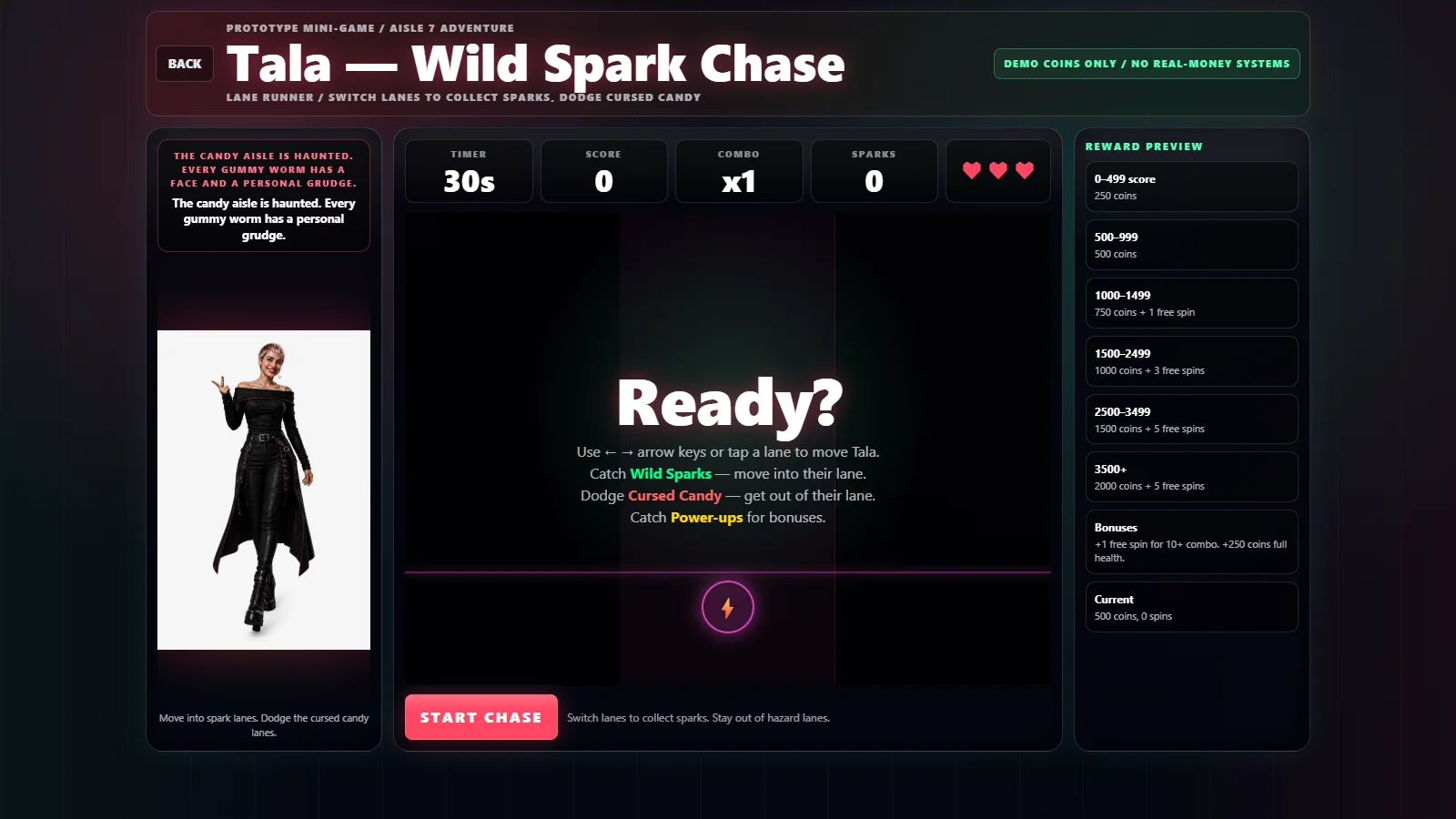
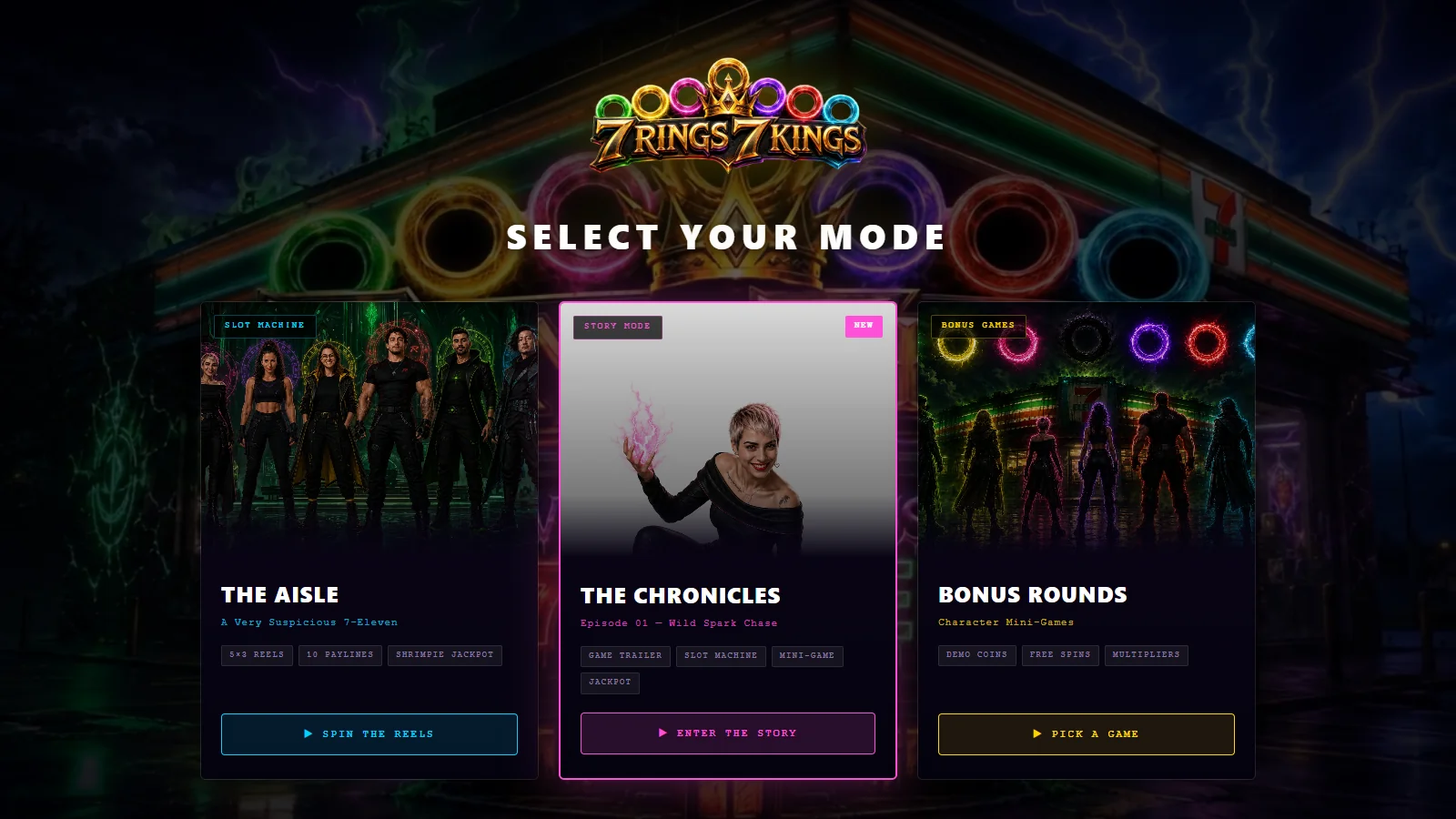
7 Rings 7 Kings keeps the reel-spin engine — because it works — and wraps a story around it. In Story Mode, a spin round is interrupted by a character offering a mini-game; the mini-game pays back into the slot as coins, free spins, or a multiplier; the boosted spin unlocks the next story beat. The slot stops being the destination and becomes the mechanism that keeps a small episodic story moving.
The universe behind it: six ring-bearers searching a cursed neon convenience store for a hidden seventh ring, held by Shrimpie — a tiny shrimp in a plastic seafood cup wearing a gold crown. Epic fantasy heroes, played completely straight, dropped into a 7-Eleven that does not deserve that seriousness.
Every character owns a ring, a colour, and a mini-game genre — so retention and replay value come from personality, not just from spinning again.
Every mini-game returns through the same reward contract into the slot — coins, free spins, or a multiplier — so five very different genres all funnel back into one consistent economy.
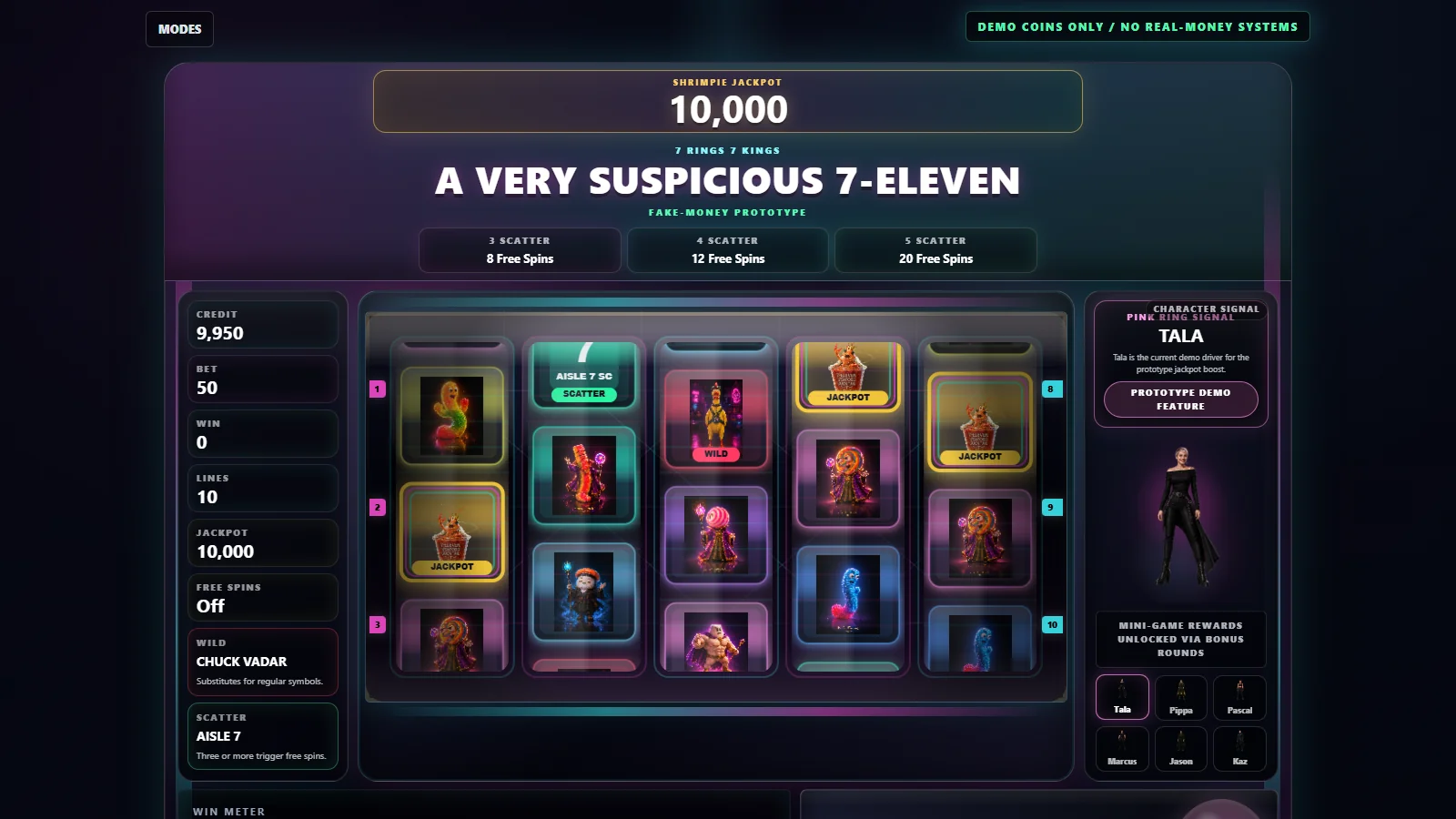
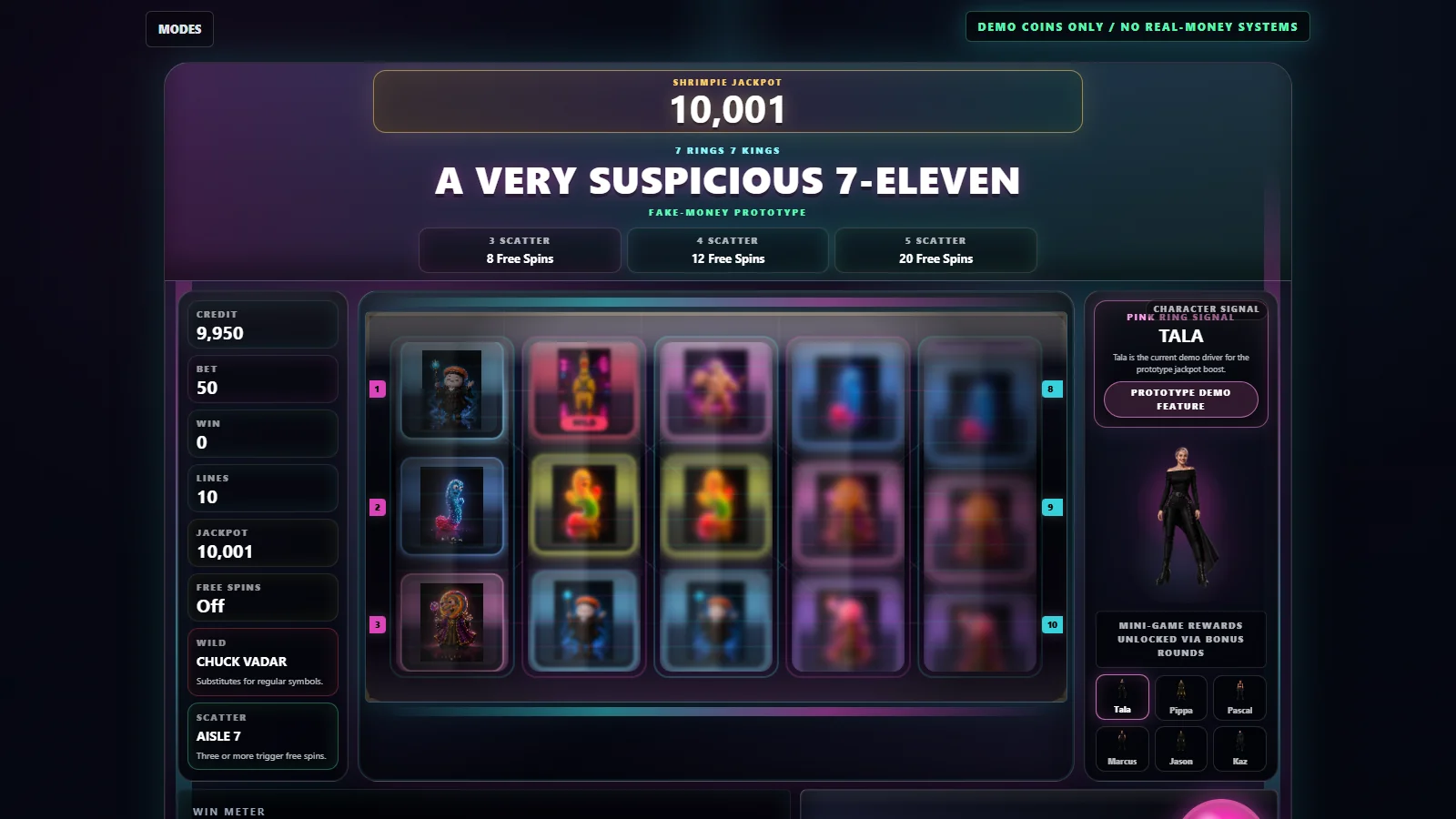
Underneath the story is a real slot engine: a 5×3 grid, 10 active paylines, explicit weighted reel strips, wild/scatter/jackpot logic, and a free-spin system — plus a standalone Node math simulator that runs sample sizes in the hundreds of thousands to sanity-check RTP, hit frequency, and volatility during development. It is not certified casino math, and the game says so everywhere; it exists to keep the design honest while iterating.
The whole thing shipped as a static Next.js export, which meant the deployment work here was as much about engineering discipline as design: the original asset set was over 300MB, dominated by a handful of high-bitrate videos and uncompressed PNGs the game didn't strictly need at that quality. Re-encoding the reachable video clips and converting the character, symbol, and background art to WebP brought the deployed build down to roughly 53MB — an ~85% reduction — with no visible quality loss.
No single tool did this. It was a small pipeline, each tool doing one job:
- ChatGPT / Gemini — concept development, system logic, prompt writing
- Claude Code — the actual game build: the slot engine, the mini-games, the story-mode state machine
- Adobe Firefly — visual exploration and character variants
- Runway — motion and video experiments
- ElevenLabs — voice and audio experimentation
- Figma — UI flow and screen prototyping
AI didn't replace the creative direction here — six characters, a story structure, a tone, a slot economy that had to make sense together — it just meant a solo creator could get from concept to a playable, presentation-ready prototype in weeks instead of never.
A fully playable Phase 1 prototype: the slot machine, a complete Story Mode loop from trailer through boosted spin, and five working character mini-games — built, tested, and shipped by one person using an AI-assisted pipeline they can name tool by tool.